Grace. How good it is.

grace

“Judge not, that you be not judged. For with what judgment you judge, you will be judged; and with the measure you use, it will be measured back to you. And why do you look at the speck in your brother’s eye, but do not consider the plank in your own eye? Or how can you say to your brother, ‘Let me remove the speck from your eye’; and look, a plank is in your own eye? Hypocrite! First remove the plank from your own eye, and then you will see clearly to remove the speck from your brother’s eye.” (Matthew 7:1-5).

There are many things that can be said about these verses, but I want to point out one area that we sometimes overlook. These verses, in a roundabout way, speak to the reality of God’s grace that sinners receive when they come to Christ. We are not to stand in judgment of others lest we forget that we, too, are sinners who are guilty of sin. Not judging others does not mean we suspend our spiritual discernment or ignore sin, but it does mean we recognize that we are no better than others. Only a hypocrite can pass judgment on another without

Continue reading

Agonizing Joy

cross_0504

“And what communion has light with darkness? God is light and in Him is no darkness at all” (2 Corinthians 6:14, 1 John 1:5).

Light and darkness are incompatible. Where the one is, the other must flee. When I was a non-believer, I detested the things of God. God was offensive to me. Of course, I couched my contempt for God in a different language. I cloaked my disdain in the language of righteous indignation. I piously proclaimed my own righteousness while heaping disdain on those who might dare to point out my deception. Then one day, the light itself came. Uninvited, it entered my sphere of consciousness, beginning as a dim glow. Even when the light was barely visible, it was enough to cleave the darkness that clung to my soul. It was through the light of the gospel that I began to see how the darkness obscured what was real. It not only clung to me, but it also enveloped me. It had entered my soul and was forming it, shaping it, sculpting it to become something entirely foreign to what God had created it to be. Of course, at the time, I did not know that God had created my soul with a purpose – until the light came. Absent this understanding, I let the dark shape me, believing that’s what I wanted.

At first, it was painful. Upon entering one’s life, the light hurts. There is an agonizing power in the light. First, it reveals what is really there. Part of the pain is in seeing this reality. All pretense to self-righteousness evaporates in its presence. It showed me who I really was. It showed me that my identity was far removed from the fantasies the darkness whispered to me in the night. It revealed to me what I desperately did not want to see. Looking into the mirror with the light on is not the same as

Continue reading

If?

Dali

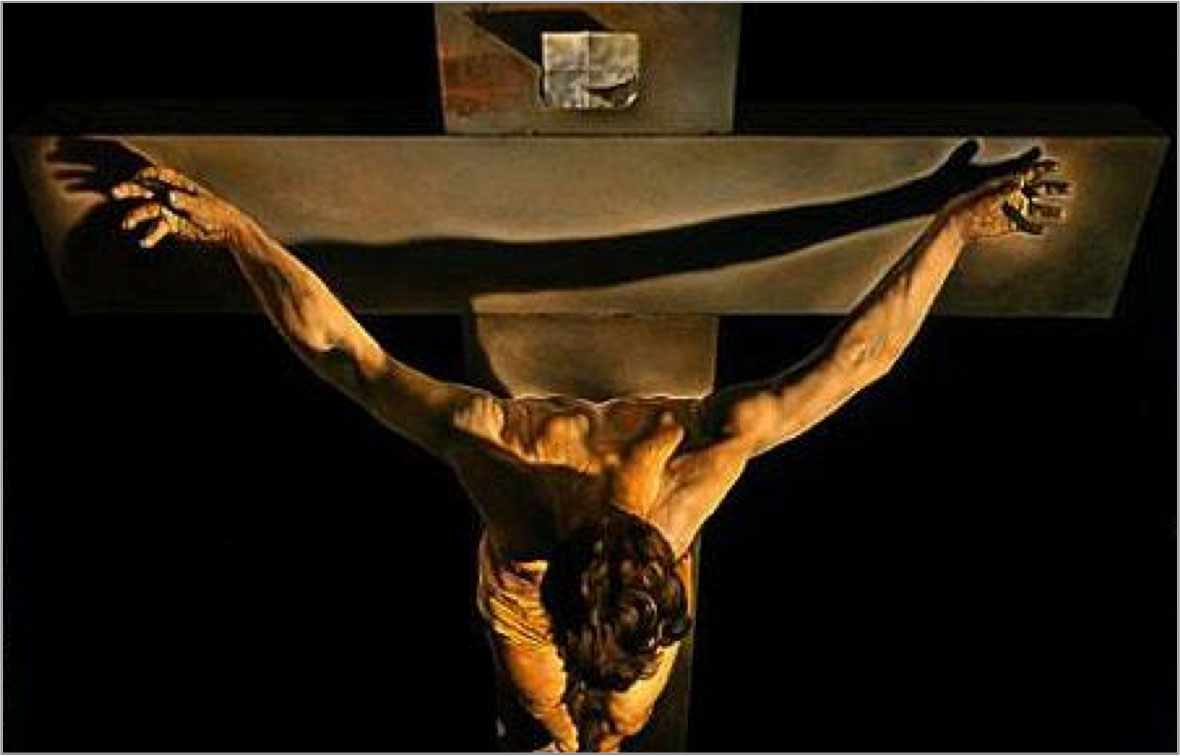
“If you are the Son of man, come down from the cross” (Matthew 27:40).

After all the people who had experienced and seen Jesus do, they yelled, “If you are the son of God….” Jesus gave sight to the blind. He healed all sicknesses, cast out demons, and even raised the dead. How short the people’s memory was when it came to remembering all he did for them. So they yelled, “Come down from the cross” as though that would be the definitive proof he was the son of God. Raising the dead did not lead them to consider the truth, but coming down from the cross would? This verse demonstrates how blind the human heart is when overcome by sin. The people were blind to Jesus’ true identity, despite his teachings and miracles. They were blind to God’s true ways, not knowing who God really is. They were also blind to the Word of God, not understanding that the Scriptures foretold that the Messiah must suffer and die. And they were blind to the love of God, not realizing he was dying for them. No, the Son of Man did not come down from the cross precisely because he was the Son of God.


God Sees

Saving-Hand-610x351

“…For the dark places of the land are full of violence” (Psalm 74:20).

The psalmist retells how the enemy of God’s people destroyed the sanctuary “Where God met with us.” There was great violence in the land. The invaders had no regard for God’s sacred things. But what is not told is why the enemy came in the first place. God’s people had deep darkness in their hearts long before the enemy destroyed the sanctuary. And in the place where they met God, they themselves had no regard for the things of God. Through their idolatry and sin, they brought spiritual darkness into God’s house. In response, God sent the enemy, so they could see just how dark their darkness was. The violence they experienced at the hands of their enemy was proportional to the violence they brought into God’s house through their idolatry. And when the darkness came to light, they felt the violence of it and longed for the light of God’s presence.

Going to the house of God does not mean we are walking in the light of God’s countenance, nor that we are truly seeking Him. God sees what is in our hearts and responds to what is truly there. And, for our own sake, He will expose what is in our hearts. God wants to meet with His people. And, He wants to bless His people. But he cannot respond to what is not there. If what is in our heart is different than what is on our lips, then God’s response will be to jar us into seeing our real spiritual condition – even if He must hand us over to what we truly long for (see Romans 1:18-32). The people didn’t know that the idolatry they practiced and loved was the same sin that drove their enemy to so great a violence against them. Their sin was one and the same. The outward violence of their enemy was proportional to the inward darkness in their own heart. So, the Psalmist gives the warning: “For the dark places of the land are full of violence.” When we allow the darkness in, violence is all that is left for us. So, Jesus said, “If then the light in you is darkness, how great is the darkness!” (Matthew 6:23).

However, Jesus came so that we may be delivered from the darkness. And He will deliver us, even when we call from its depths.


The Pathway to Fruitfulness

Faithfulness-and-Fruitfulness

Introduction

It was during the greeting time in worship that he asked me, “What’s your plan to reach our community?” He was an evangelist who was visiting the church. He and his wife had attended church for several months. I had been to his house to visit them. We had some good conversations. My answer to him was brief: “In a word,” I said, “discipleship.” He turned away as I went to shake someone’s hand behind him. I never saw him in church again. That night, as I was leaving for vacation with my family, I received a message on Facebook where he “rebuked” me. That was his word.

I was disappointed, but not surprised. Discipleship is a word that has come to mean different things to different people. But if there is one thing I have learned in ministry, it is that discipleship has lost its significance as being the foundational ministry of the church. There are many good things a church can do through ministry, but if the church is not focusing on discipleship as the focal point of everything it does, it may very well not be fulfilling the very purpose for which Christ created and commissioned his church.[1] In this article, I will argue that discipleship is the path to fruitfulness for the church. True, lasting transformational growth (both numerically and spiritually) will be most evident when discipleship is the leading vision that defines the church’s work. Hence, church growth will be most fruitful when discipleship is the church’s primary ministry.[2]

Understanding the Mission

Any discussion of church growth and the spiritual factors that lead to such growth must begin by

Continue reading

The Biblical Marks of Discipleship

Plant Sequence

One of the church’s current needs is to recover the biblical concept of discipleship. Over the past generation, the understanding of discipleship as being foundational to the mission and life of the church has been watered down. During the same period, one can find many resources devoted to the topic. However, instead of being the foundational principle upon which the church should operate, discipleship has been relegated to just one ministry amongst many within the church. During this time, the church has unofficially adopted the strategy of running programs as the necessary approach to building a healthy church. Hence, churches have children’s programs, youth programs, evangelism programs, discipleship programs, and music and worship programs, amongst many others. This partitioning of programs has led people to see discipleship as just another program within the larger church, so that it is seen as an option or preference. One person joins the choir, another goes to the discipleship class, but both are “active” in ministry. And while that may be so, as a result of partitioning the church into programs, the church is not fulfilling the great commission.

Before Jesus ascended to the Father, he made clear the purpose of the church. Every gospel account and the book of Acts communicate some version of the Great Commission. The most explicit enunciation of the Great Commission is found is Matthews’s gospel. Their Jesus said,

“All authority has been given to Me in heaven and on earth. Go therefore and make disciples of all the nations, baptizing them in the name of the Father and of the Son and of the Holy Spirit, teaching them to observe all things that I have commanded you; and lo, I am with you always, even to the end of the age. Amen” (Matthew 28:18-20, NKJV).

From this text, it is clear that the Great Commission is not limited to evangelism. And while the church has always understood that the Great Commission is a command to lead people to Christ, it has not always embraced

Continue reading

Success Realized

I have come to the pinnacle of success in business. In the eyes of others, my life has been the symbol of success.
However, apart from work, I have little joy. – The last words of Steve Jobs

Self. It’s the world’s number one killer today. It destroys marriages. It rips communities apart. It leaves children orphans. It threatens social stability at every level. It damages lives. It leaves people bereft of friends and loved ones. It is the source of wars and fights. And it is the real reason we must tragically open graves on a daily basis.

When Adam and Eve first sinned, they didn’t just break a simple rule. They effectively opened the door of Pandora’s Box, unleashing hell. Man was created in God’s image. It’s something we don’t reflect upon often enough. There are many things that mean, but one consequence of this wonderful truth is that being made in God’s image means we were given great creative skills and abilities – abilities that far surpass those of the animal kingdom. Man’s ability to cultivate, build, think, imagine, and create is vast. But man was created to do these things in a way that reflects the creator back into the creation. But because of Satan’s lie, man’s abilities were hijacked. We were created to serve God. After God created Adam, he told him to tend and keep the garden God had created. The words in the original language are the language of worship. Adam and Eve were to bend all their ingenuity in the service of their God. But when they accepted the lie of Satan, all those abilities were now placed in the service of self. Focusing those abilities on oneself has become the source of much evil in the world.

This is not to suggest that good things aren’t accomplished today or that people always and only do things that are inherently evil. It does mean, though, that most things in life are not done for God. Most people engage in the various activities of life with themselves in mind. Daily, we go through life pursuing our ambitions and dreams. We think about our future, our jobs, our daily objectives, our next big score, our likes, our dislikes, etc. etc., etc. … but rare is the person who thinks about these things in relation to God, and rarer still

Continue reading

Divide the Word, Not Believers

So I just finished a debate – if you can call it that – with a man who forcefully argues for a hyper-Calvinist position on the atonement. We sat down for coffee a couple of weeks ago and somehow got into a debate over Romans 9. Let me say upfront that there are many good Christians who are hyper-Calvinists, and there are many good Christians who are not. I belong to the latter category. I assume the conclusion of the story, based on his comments on FB, is that he has broken fellowship with me. In our discussion of Romans 9, I presented a reading of the text that differed from his. On FB, without articulating what I actually said about Romans nine, he told anyone reading that I vehemently oppose God’s sovereignty in salvation, that I dishonor God, and that I despise the sovereignty of God. When I called him a Calvinist, he said I was disparaging him and that he does not accept such titles – he even said I was disparaging Calvin. I thought I was being accurate based on his argument. He thought I was being divisive. One of the things I took away from his comments, in which he accuses me of dishonoring God, is that because I disagree with him, I am therefore dishonoring God. To dishonor God is a serious thing. It is to be living in sin and rebellion against God. To accuse someone of dishonoring God because of theological differences is a scary place to be. You might as well make the claim “To disagree with me is to disagree with God.” Where did we ever get the idea that disagreement over theological arguments is A. equivalent to attacking God; and B. grounds for accusing a brother in Christ of being in sin; and C. grounds for breaking fellowship? Friends, this is not Christianity. This is insanity.

As far as my reading of Romans nine, in a nut-shell I believe Paul is explaining why God’s promises to the Jews have not failed. It seems that the point of contention comes from the verse that reads, “Jacob I loved but Esau I hated” (Rom 9:13). Hyper-Calvinists insists that this means God chooses who gets saved, and conversely, God chooses who goes to hell. I think that is a misreading of the text. That verse is a quote from Malachi 1:2. It is my contention

Continue reading

God Gives Life

Jesus is the good shepherd who came to give us life, and to give it to us in abundance. Life is precious. Of course, you wouldn’t know that by listening to modern political theory that encourages abortion and teaches that life is to be seen through a utilitarian lens, or by watching the majority of television shows where violent death is seen as a form of entertainment, and certainly not by playing one of the many video games kids now entertain themselves with. Such things only cheapen the value of life. But the reality is that those things exist because sin exists. The Bible says that the wages of sin is death. In the presence of life sin is like a corrosive acid that eats away at the value of life, producing only death.

But one of the awesome truths of our existence is that we were created to live forever with God. We were created immortal, if you will. However, because of sin our lives were stripped from us; and what we experience as life, outside of God, is but a shadow of what we were created to experience. Sin is the reality that severs us from God’s life giving power.

In the world we can find things to Continue reading

Unleashing the Power!

Much mischief has come to the church from people operating on manmade expectations. People like busyness, and they like productivity. But, some people seldom consider the impact that is being made for the Kingdom of God. I had a conversation with a man who told me about all the wonderful stuff his church was doing just a couple of years ago. However, he forget to mention the crisis that took place during that time: the number of people who left; the conflict in the church staff; the dishonest way certain committees attempted to manipulate church circumstances; the many people who weekly attacked the pastor after every sermon – and oh, there was the deacon who left his wife and kids and ran off with a woman in the choir half his age – oh those good old days! But, the church had programs, and appeared to be productive!!

And people wonder why churches cannot reach their communities. We have forgotten the gospel. The gospel is not about busyness and programs and productivity. It is about life transformation. It is about becoming a new creation in Christ. It is about righteousness and Godliness. It is about having the entirety of one’s life turned upside down – or should I say, turned right side up. It is about learning to live for God, as one learns to love God. That may not be very flashy. It may not have the outward appearance of being “productive,” whatever that means in the economy of God’s kingdom. But, it is the very heart of the gospel.

Paul said “I am not ashamed of the gospel for it is the power of God unto salvation….” The church that expects to see power again (we once called that revival) must make the gospel the center of church life. I don’t want the “good old days” to come back to the church. I want the power of God to rock the foundations of the church!

A couple of weeks ago there was an earthquake about sixty miles from where we live. A friend’s house now has a nice long crack on his basement floor because of it. The power of that earthquake reached far beyond its epicenter and impacted by friend’s house sixty miles away. The church will reach its community only when it learns that the gospel can unleash the power of heaven. When it does, homes and lives and families far from the church will feel the impact.

The reality is that the church that does not know the power of God must substitute true transformation with superficial busyness. A pox on that house! Let us get back to the gospel! And maybe God will have mercy and pour out the fullness of His Spirit, so we can once again see lives transformed through the gospel of our great God and Savior, Jesus Christ!